sexta-feira, 8 de julho de 2011

OLYMPIC GAMES


When did the Olympic Games start?

The first Olympic Games took place in Olympia, Greece, in 776 B.C.  
They lasted for one day and had only one event – a foot race the length of the stadium - and only men competed.
Nowadays the Olympics have several hundred events for both men and women, and they last for over weeks.  They are a multi-million-door extravaganza, and many people feel that the games are now more concerned with money and politics, than with athletic competition.
The ancient games in Olympia ended when the Romans conquered Greece, and none were held for 1500 years. However, when the ruins of the stadium of Olympia were discovered in 1875, a Frenchman, Baron de Coubertin,
decided to organize a modern international Olympics. These are first held in Athens in 1896 and are now held in different country every four years.
The modern Olympics consist of summer and winter games. Baron de Coubertin was also responsible for the Olympic symbol of five rings, which are black, blue, green, red, and yellow, and represent the five continents.
The ancient Olympics were held in honor of Zeus, the supreme Greek god.
The last match games took place in Athens in 2006, and watched on TV by 3.8 billion people around the world.

Vocabulary


Took place                 
B.C.
A.C.
Foot race
Length
Concerned
Ancient
Held

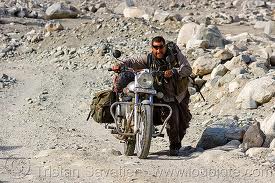
BORN TO BE WILD! - Do you like Motorcycling?

Marcos: You’ve got a motorcycle, haven’t you?

Eric: Yes, I have two.
Marcos: What kind?

Eric: I have a BMW big touring bike and I have a Suzuki off-road type.
Marcos: A BMW is a German bike, isn’t it?

Eric: That’s right, yes. Made in Germany. Even though I live in here in Brasil, I have a German-made motorcycle.

Marcos: Why did you get a German motorcycle?

Eric: Well, I have been doing a lot of camping and touring on my motorcycle so this big motorcycle is able to carry a lot of weight comfortably and safely and also this motorcycle is wind-tunnel tested so it does really really nicely on the expressway. I commute to work on the expressway four days a week so it is really good for that.

Marcos: And when you go touring, you go camping?

Eric: I often like to camp. Once in while I’ll stay in a cabin but I often take the camping gear and stay in tents.

Marcos: So you ride on winding mountain roads up through the Minas Gerais mountains until you find a beautiful place and then you just pitch your tent and light a fire?

Eric: Well, usually I have a plan as to where to go but yes we like…I prefer nice windy twisty mountain roads.

Marcos: A lot of people only know the shore beaches of Brasil, but they don’t realize that a huge area of this country is serrados e many wonderful planaltos e some caatingas in the northeast.
A perfect place to get a ride with motorcycles and make camping.
Next time you are going to trip on vacations or in a holydays off; plan to know national parks.
There are many of them around the country mainly in São Paulo, Minas Gerais, Bahia and Goias and Maranhão and Mato Grosso.

Galapagos Island:


1 – The Galapagos are an isolated group of volcanic islands on the Equator, 600 miles west of Equator.
There are thirteen big islands and six smaller one in the group and many tiny islets( ilhotas).
Five of the islands are inhabited with a population of about 9,300 people who make a living mainly from tourism, fishing, and farming ( pesca e agricultura).
Santa Cruz is the second largest island in the Galapagos.
It has the largest population because all the tourism is there.

2 – A bishop from Panama discovered the Galapagos islands´ in 1535.
The bishop (bispo) named the island after the giant tortoises (tartarugas) that live there.
The tortoises provided fresh meat (carne fresca) for sailors (pescadores), pirates, and seal and whale hunters ( gaivotas e caçadores de baleia) ,

who used the islands as a base for next three centuries.


3 – Charles Darwin visited the islands in 1835 and stayed for five weeks, observing the wildlife ( vida selvagem).
Equador officially claimed the island in 1832, and the Galapagos became a national park in 1959.

4 – The islands are famous for their incredible wildlife and beautiful scenery. The Galapagos are a very popular tourism destination.
20,000 people visited in 2003, but only if you a lot of money! It is of the most expensive place in the world to visit because the fair-trade the consuming products (consumo de produtos industrias e comerciais)re necessary to bring far from the islands.

SYDNEY - AUSTRALIA

Sydney


waves and immigrants

Introduction

Sydney is Australia's most famous city and many people
think it (muita gente pensa que é) is the capital of Australia, it is only
the capital of the state of New South Wales.
t is the biggest and oldest city in Australia.

History

In little more than two hundred years Sydney become (tornou-se) the most multi-cultural city in Australia with a population of more than four million.
The first wave of immigrants came (pirmiras ondas de migração) to Australia from Europe, then in the seventies immigration was mostly from Asia.
Now Australia has a mixed culture.
Sydney has absorved this mixture of cultures (absorveu esta mistura de culturas) Japanese, Korean, Chinese and Thailand too.

Lifestyle

The climate has eight months of good weather, makes Sydney the perfect city for an outdoor life (vida ao ar livre).


What's more, the city has more than thirty beaches along the sixty kilometres of its coast.
in Sydney harbour, one of the world's most spectacular bays (baias), you can find The Sydney Opera House, Australia's most know building.
passing by the Opera House is a constant parade of small boats, yachts, ferrie-boats and enormous cruise ships (navios de cruzeiro).
Shorts and sandals are the most popular clothes to wear for Sydney's citizens, and beer, of course, is the most popular drink. Christmas is celebrated in the sun, with a swim and a barbecue churrasco).
in Sydney a Californian lifestyle has been combined with European influences in its pubs, cinemas, theatres and concerts.

Future

In a short time Sydney has come a long way. The 2000 Olympic Games has put Sydney even more in the spotlight (evidencia). Sydney is a city looking towards (olhando direto para)the future.

THE MOST POPULAR VIDEOS

HI SUPERs!

TODAY´S INDICATION:

THIS IS AN AMAZING WEB-SITE WITH MANY VIDEOS 
WITH SUB-TITLES.
A GOOD WAY TO WATCH AND LEARN MORE!
CHECK IT UP THIS LINK BELOW:


http://www.englishcentral.com/watch

http://www.englishcentral.com/watch/video/11836/do-you-speak-english

sábado, 11 de junho de 2011

Direct and Indirect Speech

There are two main ways of reporting people’s words, thoughts, beliefs etc.


Direct speech

We can give the exact words that were said.
This kind of reporting is called direct speech.

* She said, ‘What do you want?’
* Peter said, ‘It is not my fault.’
* Jane said, ‘Are you coming with me?’
* He said, ‘I don’t want to talk to you.’
* Monica says, ‘You look beautiful.’
* Mother said, ‘Stop talking.’

Indirect speech

We can report a speaker’s thoughts and words in our own words,
using conjunctions and changing pronouns,
tenses and other words where necessary.
This kind of reporting is called indirect speech.

* She asked what I wanted.
* Peter said that it was not his fault.
* Jane asked me if was going with her?
* He said that he didn’t want to talk to me.
* Monica says that I look beautiful.
* Mother asked her children to stop talking.

sexta-feira, 3 de junho de 2011

How do you make feijoada?

Mark has a Brazilian Neighbour. He asked her how to make feijoada.


Mark: How do you make feijoada?
Brazilian Neighbour: To make a feijoada you need black beans, chorizo…
Mark: That is a kind of sausage, isn’t it?
Brazilian Neighbour: It is. Spanish sausage.
Mark: Uh-huh.
Brazilian Neighbour: You can also get a Portuguese chorizo
Child: Daddy…..!
Brazilian Neighbour: And also you need…you need pork.
Mark: Yeah. Like a piece of pork?
Brazilian Neighbour: A piece of pork. M-hm. And you also need bay leaf.
Mark: Ah!?
Brazilian Neighbour: Put a little bay leaf in there. And you need paprika and you need cumin. And also you need coriander. Coriander..
Mark: Fresh or seeds or …?
Brazilian Neighbour: Fresh. Fresh.
Mark: The leaves?
Brazilian Neighbour: The leaves. Yeah. You put it right in the end.
Mark: Right. OK. Wow!
Brazilian Neighbour: So that is the ingredients. First you need to soak the beans overnight.
Mark: Right.
Brazilian Neighbour: Right. And then…Normally I have a pressure cooker.
Mark: Yeah? So it does it quickly?
Brazilian Neighbour: It does it quickly. Yeah. It only takes about a half an hour.
Mark: It is good to soak them though.
Brazilian Neighbour: Yeah.
Mark: Germinate. Grow a little bit.
Brazilian Neighbour: So..Alright then..You put the beans into the pressure cooker, water, then you put the pork meat and you put also the chorizo in it
Mark: Yep.
Brazilian Neighbour: And in another pan you chop up some onion and garlic and you fry it with olive oil and you put it into the beans …
Mark: Yep.
Brazilian Neighbour: And you cook that for about half an hour.
Mark: Right.
Brazilian: And then.
Mark: All in the pressure cooker?
Brazilian Neighbour: All in the pressure cooker…Yeah…